

More than 270,000 disrupted air passenger journeys.
There were certainly plenty of options we could consider for this week’s media training and crisis communication blog.
The latest developments in the case of the Andrew formerly known as Prince and the continual drip feed of new revelations was a consideration.
As was the ongoing attention around Sir Jim Ratcliffe’s remarks about the UK being “colonised”.
But I ultimately opted for a more bizarre, yet damaging story.
Step forward Thomas Woldbye.
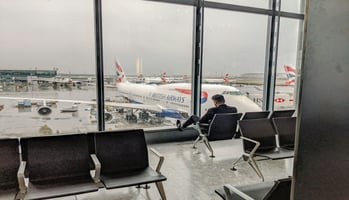
The Heathrow Airport boss has found himself in the headlines once again after claiming that Terminal 5 is not too busy – passengers are just walking in “the wrong place”.
Speaking at an industry event, the CEO said: “One of the jokes I have with our people is that one of the reasons Terminal 5 is crowded, which it’s not actually, is people are in the wrong place.
“One of the reasons is that all the British people choose the left and all the Europeans keep to the right. And they do that [in] both directions, so we get everybody crashing into each other, and I see that from personal experience.”
A joke at an industry event – no big deal, right?
The story was covered on the front page of the Financial Times.
And landed countless other turbulent headlines. Here are a few examples:
So, why did this gain so much coverage?
Well, during our media training courses, we use the TRUTH model to explain what makes a story newsworthy.
It stands for Timely, Relevant, Unusual, Trouble and Human.
And this story certainly ticks the ‘unusual’ box. It is an unexpected way of explaining why the terminal feels crowded.
It’s so unusual, it sounds a bit silly or implausible. Actually, make that ridiculous.
The comments also include that element of ‘trouble’ that journalists love. Appearing to blame customers for a problem they are experiencing is always, to put it politely, a bold approach.
Equally, the comments could also be interpreted as trivialising those issues, concerns, experiences and perceptions, which again is not a great look.

The other factor here is that Mr Woldbye has previous.
You may remember there was a high-profile crisis media management incident at the airport last year, where a fire at a nearby electricity substation caused a power outage at the airport.
It was an incident that caused travel chaos for nearly 300,000 passengers.
It was initially reported Mr Woldbye had gone back to bed during the early stages of the crisis to ensure he was well rested, something Heathrow described as “ill-informed misinformation".
But an internal report subsequently revealed that a silent phone had caused the CEO to be uncontactable.
The report said that his phone had “gone into a silent mode, without him being aware it had done so, and he was asleep at the time”.
The upshot of this was that a narrative emerged of the boss sleeping on the job.
A reputation like that is hard to shake.
And now we can add to the mix passengers walking in the wrong direction, causing the airport's crowding.
Message development and testing
What can you learn from this?
It is another CEO foot-in-mouth example.
And it highlights the importance of bosses working with comms teams to test what they want to say ahead of media interviews or speaking engagements. Or in a message development and testing session with our experts.
Does the message sound credible?
Could it be used to create critical headlines or damning social media posts?
Is there something in your speech or that you want to say in an interview that could distract from everything else you want to say?
Important questions. But ones I feel were not asked in this example.
The result? One little part of what the Heathrow boss said grabbed all the attention – and not in a good way.
CEO communication gaffes
Perhaps the only consolation for Mr Woldbye is that he is not the first CEO to experience a foot-in-mouth gaffe like this.
When I first heard about this story, it reminded me a little of Gerald Ratner – a joke during a speech at an event where you might think journalists would not be present, triggering a surge of headlines and coverage. You can see some similarities.
A more recent example was provided by Gary Pilnick. The Kellogg’s boss suggested in 2024 that families struggling financially could eat cereal for dinner.
Speaking to CNBC, he said: “The cereal category has always been quite affordable, and it tends to be a great destination when consumers are under pressure.
“If you think about the cost of cereal for a family versus what they might otherwise do, that’s going to be much more affordable.”
Asked by the journalist if those comments could “land the wrong way”, he added: “In fact, it’s landing really well right now. Cereal for dinner is something that is probably more on trend now, and we would expect it to continue as that consumer is under pressure.”
The message did not land well. It was compared to the infamous “let them eat cake” phrase, with a large serving of “let them eat cornflakes” headlines.

Fancy another example?
Andy Street, the then boss of John Lewis, had to apologise for comments that were supposed to be “light-hearted views, and tongue in cheek”.
At a dinner, he had described France as "hopeless and downbeat" and advised people with investments there "to get them out quickly". The retailer had plans to boost its business with a new French-language website at the time, and the comments faced a furious backlash.
Another example that stays in the memory comes from Sir Tim Hunt, who resigned from his position as honorary professor at a UK university after he made comments about the "trouble with girls" in science.
He told a conference t in South Korea: "Let me tell you about my trouble with girls.
"Three things happen when they are in the lab: you fall in love with them, they fall in love with you, and when you criticise them, they cry."
Sir Tim later said he was “really sorry” and added it was "a very stupid thing to do in the presence of all those journalists".
Mr Woldbye’s comments are probbably not on the same level.
But he could have done without creating such a huge backlash and more PR damage when the airport is trying to gain support for its expansion plans.
You can’t help but wonder if he wishes he had slept through this speaking engagement.
Media First are media and communications training specialists with more than 40 years of experience.
We have a team of trainers, each with decades of experience working as journalists, presenters, communications coaches and media trainers.
Find out more about our media training and crisis communication training courses.